Okay, I will be going into more detail about the various parts of the body later, but this seemed like a good opportunity to start off with an overview.
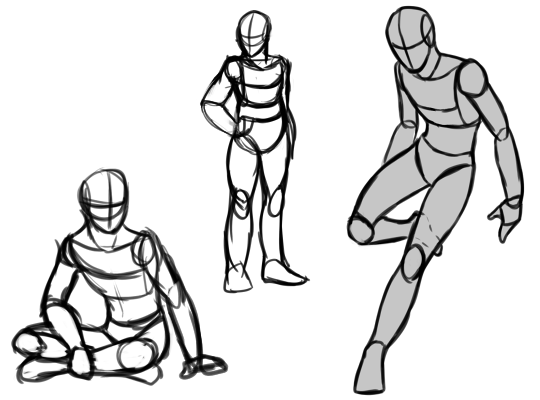
In drawing, it is generally better to start with basic shapes, before jumping right into doing all the details. That’s why many artists use a skeleton or mannequin of sorts to lay out the general shape of the body before they start on the face, hair, clothing, and so on. Different artist’s mannequins tend to look a little different, and I don’t think there’s one “right” way to do it, but here’s what mine look like:
At this early stage in a drawing, the most important things are the pose and the proportions. I’ll talk about posing in a later post, but here are my thoughts about proportions:
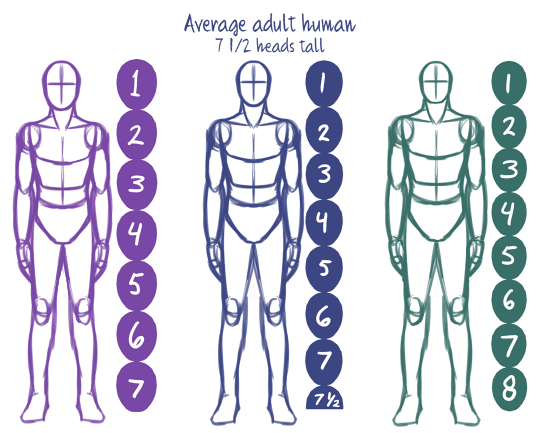
When talking about proportions, we often measure in “heads” – that is, the height of the head of the person being measured. The average adult human is roughly seven and a half heads tall, although there is some variation in real life (and even more variation in stylized art!).
Characters with larger heads in proportion to their bodies (in other words, characters who are fewer heads tall) tend to look younger and/or cuter (hence, chibis).
Conversely, characters with a smaller head in proportion to their bodies (characters who are more heads tall) tend to look powerful or imposing. You’ll see this a lot with superheroes and villains and other “larger-than-life” characters.
Keeping the various parts of the body in proportion to each other can be a challenge. Here are some of the rules-of-thumb I use to help keep things from getting too wonky:
The legs are roughly half the total height
Elbows fall at or just below the bottom of the rib cage
Wrists are even with the crotch
The length of the hand, from the heel of the palm to the tip of the longest finger, is roughly equal to the height of the face, from chin to hairline



 Izzie’s tumblr archive